
 TR
TR
 EN
EN


ABSTRACT
Objective
The aim of this study was to evaluate the distribution of viral pathogens in pediatric patients presenting with respiratory tract infection symptoms and to assess their variations according to age groups, SEX, seasons, and years. In addition, the role of multiplex polymerase chain reaction (mPCR) assays in epidemiological surveillance and clinical practice was discussed.
Materials and Methods
Nasopharyngeal swab samples obtained from patients under 18 years of age between 2022 and 2025 in a university hospital were retrospectively analyzed by the mPCR method for viral pathogens. A total of 192 patient data were evaluated. Viral and bacterial agents were identified using the Bosphore Respiratory Pathogen Panel v4/v5 kits. Statistical analyses were performed using SPSS version 23.0 (IBM Corp., Armonk, NY, USA).
Results
The most frequently detected viral pathogens were rhinovirus (30.3%), respiratory syncytial virus (RSV)A/B (27.8%), and influenza A (6.7%). Co-infection rate was 19.8%, with the most common combinations being rhinovirus+enterovirus and rhinovirus+RSV A/B. RSV A/B and rhinovirus were detected throughout the year, with RSV A/B being predominant in winter months (december-february) and rhinovirus mainly in january-february. Influenza A/B cases peaked during November–January, while enterovirus infections were most frequent in may-june. RSV A/B was significantly more common in children under one year of age (p< 0.05). Pathogen distribution differed significantly by year (p= 0.01) and age group (p< 0.001), but not by sex (p> 0.05). A statistically significant increase in the number of test requests was observed in 2024.
Conclusion
mPCR assays facilitate clinical management by providing a rapid and sensitive diagnosis of pediatric respiratory tract infections and contribute to the acquisition of epidemiological data. Our study demonstrated that rhinovirus and RSV A/B circulate throughout the year, with RSV being predominant particularly in infants, highlighting the importance of considering seasonal test planning. Additionally, by drawing attention to the uncertainty in interpreting co-infections, this study provides valuable scientific data that may form the basis for further research. Since PCR detects nucleic acids rather than viable microorganisms, it is important to interpret the results in conjunction with clinical findings.
KEYWORDS
Respiratory tract infections, multiplex PCR, RSV
INTRODUCTION
Respiratory tract infections are among the most common illnesses in childhood and constitute one of the leading causes of hospital admissions and antibiotic use, particularly in children under five years of age (1). These infections may be of viral and/or bacterial origin, and polymicrobial co-occurrence is frequently observed (2). The inability to consistently distinguish between viral and bacterial infections based on clinical and radiological findings complicates both diagnosis and management (3). As there are no pathogenspecific symptoms, a definitive diagnosis can only be established through microbiological testing (4). In pediatric patients, avoiding unnecessary antibiotic use, initiating timely and appropriate treatment, and reducing hospitalization rates and length of hospital stay all depend on rapid and accurate diagnosis (5). Nucleic acid-based methods are frequently preferred for the diagnosis of viral respiratory infections, especially in hospitalized patients. With advances in molecular diagnostic techniques, test systems sensitive to multiple targets, such as multiplex polymerase chain reaction (mPCR), have become important tools for identifying etiological agents in respiratory tract infections. These tests facilitate appropriate patient management and infection control measures by enabling rapid and highly sensitive detection of pathogens, as well as the simultaneous identification of multiple infectious agents (2,4). Prior to the coronavirus disease-2019 (COVID-19) pandemic, the co-circulation and seasonal variation of respiratory viruses in the community were common. During the pandemic, the circulation patterns of viral respiratory pathogens changed in association with the implementation of non-pharmacological interventions (6,7). In this study, it was considered that the distribution of viral agents causing respiratory tract infections in children may vary by year and season, and that co-infections may occur. The aim of the study was to identify viral respiratory pathogens in children presenting with symptoms of respiratory tract infection and to evaluate their distribution, their relationship with demographic characteristics, and their variation across years and seasons. This study is significant in that it provides recent regional data from the Sivas region in pediatric patients and demonstrates the temporal dynamics of respiratory tract infection agents, thereby offering a scientific basis for the periodic optimization of surveillance, vaccination, and infection control strategies. Although the number of patients in our study is limited, it provides valuable data that may serve as a reference for similar studies as the use of syndromic test panels becomes more widespread.
MATERIALS AND METHODS
Ethics approval for this study was obtained from the Health Sciences Research Ethics Committee of our university with decision number 2025-06/37. In this study, the positivity rates of viral respiratory tract infection agents detected by mPCR were retrospectively analyzed in patients under 18 years of age between January 1, 2022 and June 30, 2025. Test requests were made for patients evaluated in the pediatric clinic who presented with symptoms suggestive of upper respiratory tract infection, such as fever, sore throat, and rhinorrhea. In order to identify infectious agents, nasopharyngeal swab samples were analyzed using the Bosphore Respiratory Pathogen Panel v4 and v5 kits (Anatolia Geneworks, Türkiye) with the real-time mPCR method. Nucleic acid extraction was performed automatically, and the samples were subsequently analyzed according to the manufacturer’s recommended protocol. The panel included 30 different pathogens. Viral targets included Influenza A, Influenza B, Influenza C, respiratory syncytial virus (RSV) A/B, rhinovirus, adenovirus, parainfluenza types 1, 2, 3, and 4, human metapneumovirus A/B, coronaviruses 229E, OC43, NL63, and HKU1, enterovirus, bocavirus, pandemic H1N1 influenza A, seasonal H1N1 influenza A, and parechovirus. Bacterial targets included Klebsiella pneumoniae, Mycoplasma pneumoniae, Salmonella enterica, Moraxella catarrhalis, Bordetella pertussis, Haemophilus influenzae type B, Staphylococcus aureus, Streptococcus pneumoniae, and Legionella pneumophila, while Pneumocystis jirovecii was included as a fungal target. Internal controls, as well as positive and negative controls, were included in each test run. Result graphs were interpreted by a specialist physician and reported as positive or negative for each pathogen. For patients who had repeated testing within the last one month, only the first test result was included in the study. Patients with missing data among the evaluated parameters were planned to be excluded from the study. A total of 192 patients with positive results were included in the analysis, and none of these patients had missing data. Demographic information of the patients, as well as the dates of sample collection and laboratory admission, were obtained from the hospital information management system. All statistical analyses were performed using IBM SPSS Statistics version 23.0 (IBM Corp., Armonk, NY, USA). The distribution of the data was assessed using the Shapiro-Wilk test. When the assumptions of normal distribution were not met, the Kruskal-Wallis test was applied. In cases where a significant difference was detected, pairwise comparisons were performed using the Bonferroni-corrected MannWhitney U test. For descriptive statistics, continuous variables were expressed as mean ± standard deviation, while categorical variables were presented as number (n) and percentage (%). The Pearson chi-square test was used to evaluate relationships between categorical variables. In groups where a significant difference was identified by the chi-square test, post hoc analysis was conducted to determine the specific cells contributing to the difference. A p-value of <0.05 was considered statistically significant in all analyses.
RESULTS
In our study, data from 192 patients under 18 years of age were retrospectively evaluated. Of the patients, 98 (51%) were male and 94 (49%) were female. Age groups were classified as 5 years (n= 29, 15.1%). A total of 182 patients (94.8%) were hospitalized, while 10 (5.2%) were outpatients (Table 1). A total of 16 different viral pathogens were identified by mPCR. The overall distribution of pathogens is presented in Table 2. The most frequently detected agents were rhinovirus (n= 71, 30.3%), RSV A/B (n= 65, 27.8%), and influenza A (n= 16, 6.7%).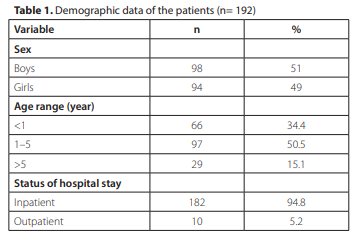
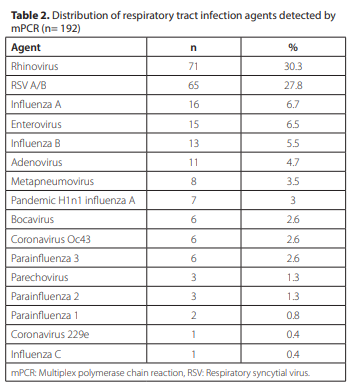
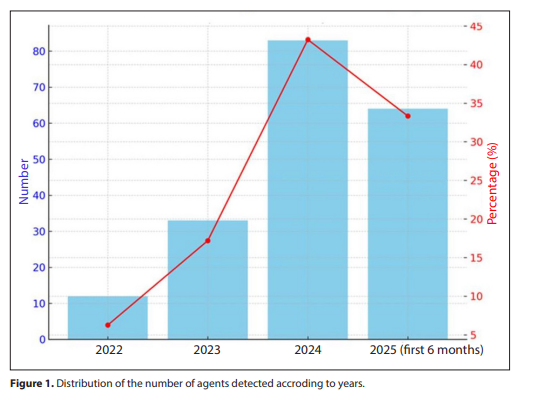
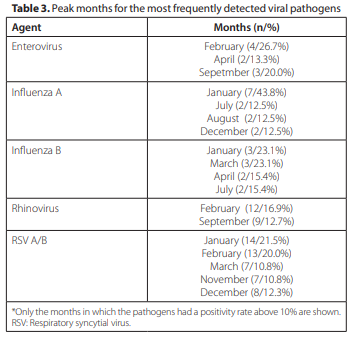
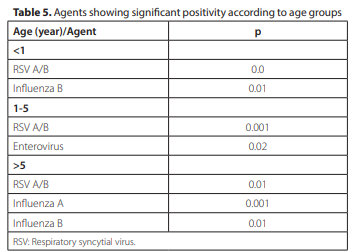
In some samples, two viral agents were detected simultaneously. Overall, 38 samples (19.8%) showed co-detection of two agents, most commonly enterovirus+rhinovirus (28.9%) and rhinovirus+RSV A/B (18.4%). The total number of positive detections by year was 12 in 2022, 33 in 2023, 83 in 2024, and 64 in the first six months of 2025. This distribution is shown in Figure 1. When the intraannual distribution of pathogens was examined, rhinovirus and RSV A/B were detected throughout all 12 months of the year, indicating continuous circulation. Among the other agents, influenza A and RSV A/B peaked during the winter months, whereas enterovirus showed a peak at the beginning of the summer season. Other pathogens were distributed across various months throughout the year. The months in which the most frequently detected viral agents were concentrated and their frequencies are presented in Table 3. The three most frequently detected agents according to seasonal distribution are shown in Table 4. When the distribution of pathogens was analyzed according to years, age groups, and sex, statistically significant differences were found between years (p= 0.01) and age groups (p= 0.00). Post hoc analysis revealed that rhinovirus and RSV A/B isolations were significantly higher than expected in 2024, whereas rhinovirus detection rates were lower than expected in 2022 and 2023. Pathogens showing statistically significant differences according to age groups are presented in Table 5. No statistically significant difference was found in comparisons based on sex (p> 0.05).
Monthly test request numbers by year are presented in Figure 2. Statistical analysis demonstrated a significant difference between years (Kruskal-Wallis, H= 15.10, p= 0.00). Post hoc analysis indicated that this difference was primarily driven by data from 2024. The number of test requests in 2024 was significantly higher compared to 2022 (p= 0.00) and 2023 (p= 0.01), while no significant difference was observed between 2022 and 2023 (p> 0.05). These findings indicate a marked increase in test requests in 2024. The year 2025 was excluded from this analysis, as it only included data from the first six months.
DISCUSSION
Respiratory tract infections remain one of the most common causes of hospital admissions and antibiotic prescriptions in childhood. With the introduction of nucleic acid-based tests into clinical laboratories, the pathogens responsible for these infections have become easier to detect. These tests enable detailed epidemiological data to be obtained and allow for more effective patient management through rapid results. 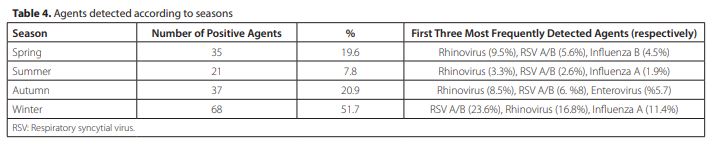
The findings of this study demonstrate that viral pathogens detected in pediatric respiratory tract infections vary according to seasons, age groups, and years, and that mPCR panel tests may play a critical role in epidemiological surveillance and clinical management. Several meta-analyses have reported that the clinical significance of viral co-infections detected by molecular methods remains unclear and that the increased mortality risk observed in children with viral co-infections requires further investigation (8,9). In a systematic review by Goka et al., co-infection rates in studies including children under six years of age ranged from 5% to 62% (mean 23%) (8). Various studies conducted in pediatric populations have reported co-infection rates of 10.2%, 9.1%, 16%, 6.2%, and 20.4% (4,10- 13). In the present study, a co-infection rate of 19.8% was observed, consistent with the literature, and rhinovirus was the most commonly associated pathogen in co-infections. Additionally, rhinovirus was also the most frequently detected microorganism overall. Molecular panel tests used for the rapid diagnosis of lower respiratory tract infections can identify a wide range of pathogens. However, a detected virus may persist in the respiratory tract following a recent infection. PCR-based molecular tests detect the presence of nucleic acids belonging to the target microorganism but cannot determine whether the organism is viable. Therefore, microorganisms detected by PCR may not always represent active infection. These agents may be present as part of the upper respiratory tract flora or may persist following previous infections without complete eradication. Viral damage to the respiratory epithelium and abnormal inflammatory responses are important in increasing susceptibility to secondary bacterial infections. Viral coinfections may facilitate bacterial invasion into normally sterile areas of the respiratory tract, potentially leading to bacterial complications (14). Based on these considerations, diagnostic methods capable of detecting multiple viral and/or bacterial co-infections can play a crucial role in both treatment decisions and infection control measures. In several studies using similar methodologies, the most frequently detected viral pathogens were rhinovirus and RSV A/B, consistent with our findings (3,4,10,11,15,16). Along with RSV A/B, rhinovirus is one of the leading causes of viral bronchiolitis in infants, and RSV A/B is a major cause of lower respiratory tract infections in children under one year of age (17). In a study investigating RSV A/B frequency in children diagnosed with lower respiratory tract infections, all patients positive for this agent were reported to be under one year of age (18). RSV A/B infections can lead to hospitalizations and a substantial number of outpatient visits in infants and young children, resulting in a significant economic and disease burden. Furthermore, evidence suggests an association between early-life RSV A/B infection and recurrent wheezing or asthma-like symptoms (19). In our study, consistent with the literature, RSV A/B was significantly more frequent in children 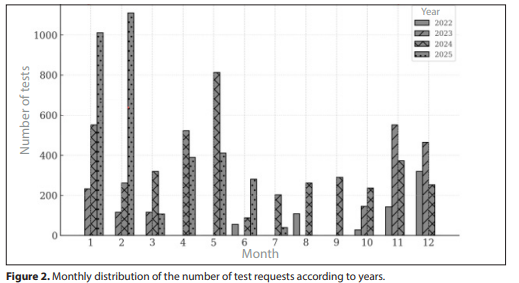
under one year of age. Early diagnosis of such age-specific pathogens using PCR testing may contribute to reducing disease burden. Considering the seasonal patterns of respiratory tract infections, the seasonality of certain pathogens is noteworthy. Studies have shown that each 1 °C decrease in air temperature during winter is associated with a significant increase in mortality rates, approximately 33% of which is related to respiratory tract infections (20). In their study, Gülen et al. reported that RSV A/B infections peaked between December and February, while influenza peaked in November and December (21). Another study indicated that respiratory tract infections were most frequent in winter, followed by spring, summer, and autumn (10). Biçer et al. found that influenza A and B were more common in winter/spring, RSV A/B in autumn/winter/spring, while parainfluenza viruses and rhinovirus showed no clear seasonality and were observed year-round with fluctuating incidence (13). Similarly, in our study, rhinovirus and RSV A/B were detected throughout the year, most frequently in January and February, while influenza A/B and enterovirus exhibited seasonal variability. Other viral agents were distributed across different months. This distribution supports the need for seasonally informed diagnostic approaches and testing algorithms in clinical practice. It also provides important epidemiological data for optimizing vaccination and infection control strategies. A study reported that the reduced infection burden during the pandemic period showed a sharp decline in early 2022, followed by an upward trend and increased heterogeneity among circulating pathogens (22). In our study, the increasing trend observed across the years was consistent with these findings. Notably, despite including only the first six months of 2025, the number of positive cases was considerably high. These data highlight the variability in circulating viral load and the need to optimize infection control measures and vaccination strategies. Additionally, in our institution, mPCR tests were used only in selected patients until 2023. Subsequently, increased testing capacity and broader patient inclusion likely contributed to the rise in detected cases. In conclusion, this study provides insight into the current distribution of respiratory viral pathogens in children, evaluates the field application of the mPCR method, and analyzes co-infections involving multiple agents. As with all microbiological tests, the appropriateness of sample collection in mPCR significantly affects the reliability of results. The availability of trained personnel for sample collection is essential for optimizing accuracy and reliability. A general limitation of PCR-based tests is that they detect genetic material rather than confirming the presence of viable microorganisms. Therefore, results should always be interpreted in conjunction with clinical findings. Due to the retrospective design of our study, the clinical characteristics, prior medical history, and disease course of patients with coinfections could not be evaluated, limiting interpretation of their clinical significance. Additionally, the limited sample size restricts the generalizability of regional findings. Multicenter studies incorporating surveillance data would provide more generalizable evidence. Notably, our findings not only enhance local epidemiological awareness but also contribute to the development of clinical management strategies. Furthermore, emphasizing the limitations of highly sensitive tests such as mPCR in interpreting co-infections may serve as a basis for future comparative studies (PCR vs. culture). Regular regional surveillance studies are essential for consistent data collection and interpretation. The development of standardized algorithms for interpreting co-infections will help clarify their clinical significance. Overall, this study holds scientific value in defining the distribution of respiratory viral pathogens in the Sivas region, evaluating mPCR as a rapid diagnostic tool, emphasizing that detected viral agents may represent active infection or residual nucleic acid, and contributing to the shaping of infection control policies.