
 TR
TR
 EN
EN


ABSTRACT
Objective
Neisseria meningitidis is a gram-negative diplococcus that causes meningitis and invasive meningococcal disease. Vaccination of fers protection against this pathogen, and different effective vaccines are available for different serogroups. Among these are MenACWY-TT (Nimenrix®), targeting serogroups A, C, W, and Y, and 4CMenB (Bexsero®), targeting serogroup B. Since meningococcal vaccines are not included in the national immunization schedule, they are administered upon phy sician recommendation and parental request. The most common side effects are fever and irritability. This study aimed to compare the inci dence of fever and other adverse effects between the simultaneous and separate administration of Nimenrix and Bexsero vaccines.
Materials and Methods
Between February 2017 and September 2024, we evaluated the side effects of Nimenrix and Bexsero vaccines administered simultaneously at different anatomical sites and at different times in our outpatient clinic.
Results
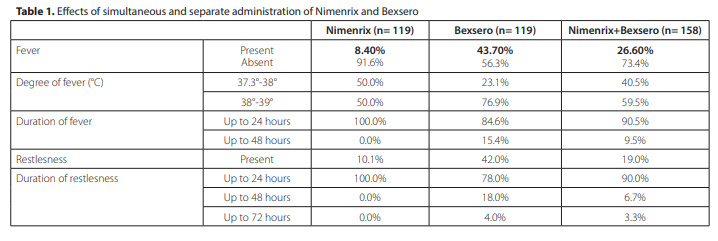
Our findings showed that the simultaneous administration of Nimenrix and Bexsero did not increase the incidence of fever (26.6%). Bexsero administered alone resulted in a higher rate of fever (43.7%). In contrast, the group that received only Nimenrix had a significantly lower incidence of fever (8.4%).
Conclusion
Considering adverse effects and national vaccination prac tices, we suggest that both vaccines can be safely administered simulta neously at 3, 5, and 13 months.
KEYWORDS
Meningococcus, meningococcal vaccines, nimenrix, bexsero, adverse effects
INTRODUCTION
Neisseria meningitidis is a gram-negative diplococcus that causes meningitis and invasive meningococcal disease (IMD). Global data from 2010–2018 show that serogroup B (MenB) has become the leading cause of IMD, while serogroup C (MenC) remains endemic. Rising trends have also been report ed for serogroups W (MenW) and Y (MenY) (1). In a multicenter study from Türkiye (2017-2018), N. menin gitidis was the most frequent pathogen in bacterial meningi tis. Serogroups B (54.7%) and W (7.5%) were most common, with 34.8% of the cases in children under one year (2). These findings emphasize the importance of early vaccination. In a prior study (2013-2014), serogroup W accounted for 42.4% and B for 32.9% (3). This variability over time underscores the need for early protection against both serogroups (4). Vaccines offer effective protection against IMD. Available types include conjugate tetravalent, recombinant monova lent, and newer conjugate pentavalent vaccines (5). Nimenrix is a conjugate tetravalent vaccine (MenACWY-TT), approved from six weeks of age, with two doses two months apart and a booster at 12 months (6). 4CMenB vaccine Bexsero targets serogroup B through re verse vaccinology. It is approved for use from two months of age, with two primary doses given two months apart and a booster dose recommended between 12 and 15 months of age (7). The pentavalent conjugate vaccine Penbraya (Men ACWY-TT/MenB-FHbp) targets individuals aged ≥10 years, especially where both MenACWY and MenB coverage is need ed (8). Thus, protection against serogroups A, C, W, Y, and B in early childhood requires two separate vaccines. This study compares side effects, particularly fever and ir ritability, of MenACWY-TT (Nimenrix) and MenB-4C (Bexsero), which are not yet included in the national immunization pro gram of Türkiye and are administered upon physician recom mendation or parental request. It also aims to inform future decisions on their inclusion and optimal scheduling.
MATERIALS AND METHODS
This retrospective observational cohort study was con ducted after obtaining approval from the Bahçeşehir Univer sity Clinical Research Ethics Committee (Approval number: 2024-03/02), dated October 16, 2024. The ethics approval cov ered the retrospective evaluation of data from patients vaccinated between February 2017 and September 2024 in our outpatient clinic. The study population consisted of three groups: 119 chil dren who received the MenACWY-TT (Nimenrix) vaccine alone, 119 who received the MenB-4C (Bexsero) vaccine alone, and 158 who received both vaccines during the same visit. In the simultaneous administration group, the two vaccines were in jected into different anatomical sites, typically the right and left thighs. All vaccinations in this study were performed following informed consent from the caregivers, after detailed expla nation of the available options. The choice to receive either one or both vaccines during the same visit was entirely based on parental preference. Vaccines were administered only to children who were clinically healthy on the day of vaccination, with no signs of fever or active infection. No prophylactic an tipyretics were given prior to vaccination. Our outpatient clin ic maintains active communication with families during the post-vaccination period. Parents were encouraged to report any post-vaccination symptoms, particularly fever or irritabil ity, by phone on the same day. In addition, these symptoms were re-evaluated at the subsequent routine clinic visit, allow ing verification and correction of any incomplete or unclear information. In cases where no symptoms were observed, this was also explicitly documented during follow-up. We believe that this close and structured communication with caregivers contributed significantly to the reliability of the symptom data collected. Fever was defined as a body tem perature exceeding 37.3 °C, measured using digital temporal artery thermometers approved by the clinic. The degree of fever was categorized as mild (37.3 °C-38.0 °C) and moderate (38.1 °C-39.0 °C), based on the highest recorded temperature within the first 48 hours after vaccination. Duration of fever was calculated as the time from the first detection of fever until the temperature returned to below 37.3 °C and was grouped as up to 24 hours or up to 48 hours. In cases where body temperature exceeded 38.5 °C and persisted despite in itial observation, caregivers were advised to administer par acetamol according to age-appropriate dosing guidelines. Restlessness was defined as excessive crying, irritability, sleep disturbances, or general agitation as subjectively observed by the caregivers. Its duration was estimated by the parents and recorded in hours, then categorized into three intervals: up to 24 hours, up to 48 hours, and up to 72 hours. All defi nitions and recording instructions were explained to families during the vaccination visit, and the importance of accurate follow-up was emphasized. These instructions and definitions are part of the standard vaccination follow-up protocol rou tinely applied in our outpatient clinic. Data Collection and Exclusion Criteria Data were collected retrospectively from electronic and written medical records maintained in our outpatient vaccination clinic. Information regarding vaccine type, ad ministration date, patient age, sex, and post-vaccination symptoms (fever, restlessness, and other complaints) was extracted from standardized follow-up forms completed by caregivers and verified during follow-up visits or phone calls. Children with incomplete vaccination records, missing fol low-up data, or uncertain symptom reporting were excluded from the analysis. Additionally, patients who received antipy retics prophylactically, or who had any signs of acute illness (e.g., fever, upper respiratory tract infection, or gastrointesti nal symptoms) at the time of vaccination, were not included in the study. Statistics Statistical analyses were performed using SPSS version 25 (IBM Corp., Armonk, NY, USA). Descriptive statistics were used to summarize demographic characteristics and the distribu tion of post-vaccination symptoms across the study groups. Categorical variables, including the presence and severity of fever, as well as the duration of fever and restlessness, were compared using Pearson’s chi-square (χ²) test or Fisher’s exact test, where appropriate. A p-value of <0.05 was considered statistically significant.
RESULTS
The incidence of fever was 8.4% (n= 10) in the Nimenrix group, 43.7% (n= 52) in the Bexsero group, and 26.6% (n= 42) in the simultaneous administration group. A significantly higher rate of fever was observed in the Bexsero-only group (p< 0.001) (Table1). The incidence of irritability was 10.1% (n= 12) in the Ni menrix group, 42.0% (n= 50) in the Bexsero group, and 19.0% (n= 30) in the simultaneous administration group. Again, irri tability was significantly higher in the Bexsero-only group (p< 0.001) (Table 1). Among the individuals who received the Bexsero vaccine, the incidence of fever and irritability decreased with increas ing age at vaccination. Notably, no fever cases were reported after 13 months of age, and irritability rates dropped to as low as 9.1% (n= 1). These findings indicate that fever and irritabil ity significantly vary depending on the age at which the vac cine is administered (Table 2).
DISCUSSION
Globally, countries have adopted different vaccination recommendations based on the predominant meningococ cal serogroups and risk groups within their borders (9). The U.S. Centers for Disease Control and Prevention (CDC) iden tify complement deficiency, use of complement inhibitors, anatomical or functional asplenia, and HIV infection as risk factors for meningococcal disease (10). In its 2020 report, the CDC recommended the MenACWY vaccine for adolescents aged 11-12 years and children over two months at increased risk for meningococcal disease (10). In its updated report from

November 2024, the MenB vaccine is routinely recommended for individuals aged 16-23 years and children over 10 years of age with an increased risk of meningococcal disease (11). According to the European Centre for Disease Preven tion and Control, Italy recommends MenB at 3, 5, 15, and 24 months and MenACWY at 12 months and between 12 and 18 years. In Germany, MenB is recommended at two and four months, with MenB and MenC administered concurrently at 12 months. In France, MenB is given at three months, and both MenB and MenC are administered simultaneously at five and 12 months (12). MenB is routinely administered in the United Kingdom at two and four months, followed by Hib/MenC and MenB at 12 months, and MenACWY at 14 years (13). The intensive immunization schedule during the first six months of life in the pediatric population has raised the po tential for meningococcal vaccines to be co-administered with other routine childhood vaccines. A study conducted in Italy found that simultaneous administration of the 4CMenB vaccine with the pneumococcal conjugate vaccine, the hex avalent combination vaccine (DTaP-Hib-IPV-HepB; diphtheria, tetanus, acellular pertussis, Haemophilus influenzae type b, inactivated poliovirus, and hepatitis B), and oral rotavirus vac cine did not compromise vaccine safety (14). Another study demonstrated that co-administration of MenACWY vaccines with DTaP, HPV (human papillomavirus), hepatitis A, hepatitis B, influenza, MMR (measles, mumps, and rubella), and varicella vaccines, and MenB vaccines with DTaP, HPV (human papillomavirus), influenza, hepatitis B, and pneu mococcal conjugate vaccines, did not affect the immune re sponse and had an acceptable overall safety profile (15). A retrospective cohort study in Spain evaluated 1.255 pediatric cases under five years of age hospitalized for IMD. Of these, 96.25% (n= 1209) were healthy children with no comor bidities, while underlying pathologies were identified in 46 cases (3.65%). Among these comorbidities, 34 cases (2.71%) had congenital malformations, 7 (0.56%) cases had malignant neoplasms, and 7 (0.56%) cases had chronic pulmonary dis eases. Notably, genetic or acquired immunodeficiencies, as defined by the CDC, were detected in only 2 (0.15%) cases (16). A population-based study conducted in Denmark from 1977 to 2015 identified chronic comorbidities in 6.9% (n= 353) of 5.121 pediatric patients diagnosed with IMD. How ever, many of these cases did not meet the CDC’s criteria for high-risk classification (17). In light of these findings, it can be concluded that most pediatric cases of IMD were previously healthy and had no known comorbidities or defined risk factors. Therefore, menin gococcal vaccination appears to be indicated for the entire pediatric population. Additionally, since primary immunode ficiencies such as complement deficiencies are often not diagnosed until the second or third decade of life, prophylactic vaccination becomes even more clinically important in chil dren who have not yet been classified into a risk group (18). Meningococcal vaccines’ most common side effects in clude redness and swelling at the injection site, muscle pain, fever, fatigue, and irritability (5,19,20). In a multicenter study conducted in Europe, the five-component meningococcal vaccine MenABCWY (Penbraya) was compared with the si multaneous administration of Bexsero and Nimenrix in terms of immunogenicity, safety, tolerability, and adverse events, particularly fever. The Penbraya group exhibited higher rates of fever, decreased appetite, irritability, and injection site ten derness than the Nimenrix+Bexsero group. The study was terminated in Phase 2b due to potential safety concerns, as two-month-old infants in the Penbraya group required lum bar puncture due to fever and irritability, and pleocytosis was detected in the cerebrospinal fluid. In this study, fever >38°C occurred in 56% of participants after the first dose at 2 months, 22.3% after the second dose, and 19.3% after the booster dose at 12 months in the Nimenrix + Bexsero group. The decline in fever incidence with age aligns with the findings of our study (Table 2). Furthermore, both groups demonstrated strong im mune responses to MenB and MenACWY serogroup antigens (21). In our study, simultaneous administration of Nimenrix and Bexsero on the same day did not statistically increase the rates of fever and irritability. It resulted in a lower fever incidence than Bexsero administered alone. These findings suggest that co-administration of meningococcal vaccines in the pediatric population may offer a more favorable safety profile than sep arate administration. The hypothesis that simultaneous exposure to multiple an tigens may modulate immune activation in a more regulated manner, thereby reducing the release of pyrogenic cytokines responsible for fever, remains a topic of ongoing research (22). However, further investigation is required to elucidate this mechanism fully. This study has several limitations. First, its retrospective observational design may be subject to inherent biases, in cluding recall bias and reporting variability by caregivers. Al though data collection was standardized through caregiver instructions and systematic follow-up, the accuracy of symp tom reporting—particularly for subjective findings such as restlessness—could still be influenced by parental perception. Second, although children with overt signs of illness were ex cluded, underlying or undiagnosed medical or genetic condi tions may have influenced post-vaccination reactions in ways that could not be accounted for. Third, the study focused on short-term post-vaccination outcomes; therefore, potential late-onset adverse events or complications beyond the obser vation window could not be evaluated. Despite these limitations, the large sample size, structured follow-up process, and consistent clinical practice protocols strengthen the reliability of the findings.
CONCLUSION
In conclusion, considering the high risk of IMD under the age of one, the fact that the majority of cases occur in children without any risk factors, and the prevalent serogroups in our country, both vaccines should be administered at an early age. The observation that co-administration of Nimenrix and Bex sero results in fewer adverse effects, such as fever, suggests that simultaneous vaccination may reduce outpatient clinic visits. Due to the current national immunization program, we propose that both vaccines can be co-administered at 3, 5, and 13 months of age. Ethics Committe Approval: This study was approved by the Bahçeşehir University Ethics Committee for Non-Interventional Research (Decision no: 2024-03/02, Date: 16.10.2024). Peer-review: Externally peer-reviewed. Author Contributions: Concept - FF; Design - FF, DS; Supervision - FF, DS; Resource - FF, DS; Data Collection and/ or processing - FF, DS; Analysis and/or interpretation - All of authors; Literature search - All of authors; Writing - All of authors; Critical review - All of authors. Conflict of Interest: All authors declare that they have no conflict of interest. Financial Disclosure: The authors declared that this study has recei ved no financial support.