
 TR
TR
 EN
EN


ABSTRACT
Objective
Surveillance systems are important tools in combating infec tious diseases, monitoring disease burden and epidemiology, and de tecting outbreaks and emerging pathogens. In this cross-sectional and descriptive study, it was aimed to evaluate the distribution of notifiable diseases by years and the general characteristics of the patients by ex amining the cases recorded in the notifiable disease system of a tertiary education and research hospital.
Materials and Methods
In this cross-sectional and descriptive study, cases reported to the Ministry of Health notification system between January 1, 2019 and December 31, 2024 at İzmir Bakırçay University Çiğli Training and Research Hospital were retrospectively reviewed through the hospital information management system according to ICD-10 diagnostic codes. Patients under the age of 18 with diagnoses included in the list of notifiable ınfectious diseases ICD-10 diagnostic codes were included in the study.
Results
A total of 378 case notifications were identified. Of these, 48.7% belonged to female and 51.3% to male patients. Patients’ ages ranged from 1 day to 18 years, with a median age of 96.5 months. The highest number of notifications was made in 2024 (50.5%). Notifications were most frequently made from the pediatric emergency ward (44%), fol lowed by the pediatric infectious diseases department (17%) and the general pediatrics ward (15%). The most frequently reported disease was varicella (n= 150), followed by influenza (n= 108) and pertussis (n= 59).
Conclusion
To enhance the effectiveness of the fight against infectious diseases, it is of great importance to continuously update surveillance systems and to increase healthcare workers’ awareness regarding dis ease notification.
KEYWORDS
Notifiable infectious disease, infectious disease, children
INTRODUCTION
Infectious diseases continue to pose a significant public health threat both globally and in Türkiye. In Türkiye, infectious diseases accounted for 8.5% of all deaths in 2019, including conditions such as Human Immunodeficiency Virus/Acquired Immune Deficiency Syndrome (HIV/AIDS) and tuberculosis (1). Surveillance systems are essential tools in combating infectious diseases, enabling the monitoring of disease burden and epidemiology, as well as the detection of outbreaks and emerging pathogens. In Türkiye, the surveillance system for notifiable infectious diseases has been addressed within the field of public health since the early years of the Republic. With the enactment of the Public Health Law No. 1593 in 1930, the obligation to report infectious diseases and outbreaks was established within a legal framework (2). Over the years, taking into account changes in disease epidemiology and scientific advances in laboratory methods, the list of notifiable diseases has been expanded both in number and scope. Most recently, the list of ICD-10 diagnostic codes for notifiable infectious diseases, which initiated the opening of the notification interface in health information management systems and established reporting requirements, has been published (3,4). Accurate identification of cases and implementation of necessary measures based on collected data are crucial for effective control of infectious diseases. However, several challenges have been reported in our country, including the lack of adequate laboratory facilities in all healthcare institutions to identify etiological agents, insufficient attention given by physicians to reporting, delays in completing notification forms, and the frequent completion of these forms by non-physician personnel (5). In this cross-sectional and descriptive study, cases recorded in the notifiable disease surveillance system of a tertiary training and research hospital between January 1, 2019, and December 31, 2024, were analyzed to evaluate the distribution of diseases by year and the general characteristics of the patients.
MATERIALS AND METHODS
In this cross-sectional, descriptive study, cases reported to the Ministry of Health notification system at İzmir Bakırçay University Çiğli Training and Research Hospital between January 1, 2019, and December 31, 2024, were retrospectively reviewed through the hospital information management system using ICD-10 diagnostic codes. Patients under 18 years of age with diagnoses included in the ICD-10 list of notifiable infectious diseases were included in the study. As our hospital is one of the rabies vaccination centers in the province, it also serves patients referred from surrounding regions where such centers are not available. To avoid potential over-reporting resulting from this, rabies and rabies-risk exposure notifications were excluded from the study. Additionally, during the coronavirus disease-2019 (COVID-19) pandemic, diagnostic codes were assigned to all individuals sampled due to suspected infection, making it unclear whether these codes accurately reflected clinical status. Therefore, COVID-19 notifications were also excluded from the study. The diagnosis, age, sex, notification date, and the department where the notification was made were evaluated for each reported patient. Multiple entries of the same ICD-10 diagnostic code for the same patient (based on national identification number) were considered duplicate notifications; in such cases, only the first notification was included in the analysis. Data were retrospectively collected from the infectious disease notification system and the electronic hospital information management system. Information obtained from patient records was recorded in pre-prepared case report forms. For statistical analysis, the SPSS for Windows 29 statistical software package was used. All numerical and categorical data were analyzed using descriptive statistical methods. The chi-square test and Fisher’s exact chi-square test were used for comparisons of categorical variables. A p-value of <0.05 was considered statistically significant. Ethics approval for this study was obtained from the Non Interventional Clinical Research Ethics Committee of İzmir Bakırçay University (Approval number: 2060, Date: 19.02.2025).
RESULTS
Between January 1, 2019, and December 31, 2024, a total of 26,164 notifications were recorded for diseases included in the ICD-10 list of notifiable infectious diseases. After excluding 3.816 notifications related to rabies-risk exposure and 21.868 notifications related to COVID-19, a total of 480 notifications remained. Of these, 102 were identified as duplicate notifications and were excluded from the analysis. Consequently, a total of 378 unique notifications were included in the statistical analyses.
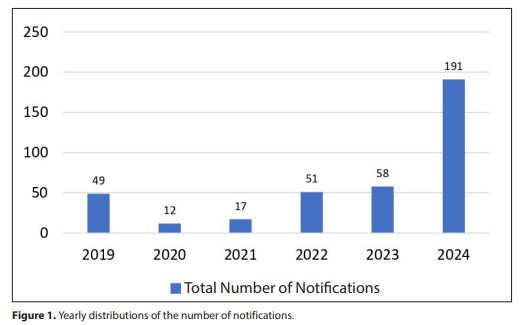
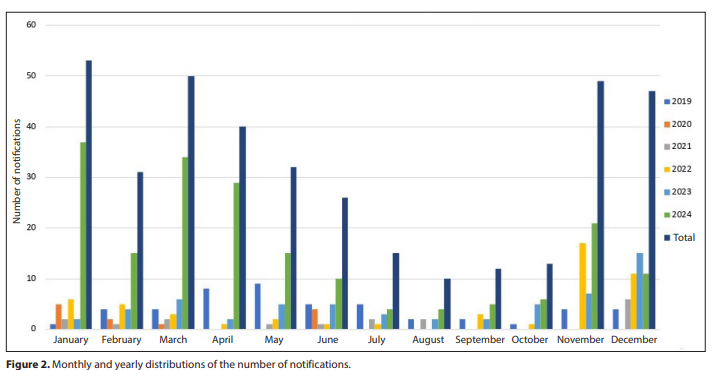
Of the notifications, 48.7% belonged to female patients (n= 184) and 51.3% to male patients (n= 194). The ages of the patients ranged from 1 day to 18 years, with a median age of 96.5 months. When the distribution of notifications by year was examined, 49 (12.97%) were reported in 2019, 12 (3.17%) in 2020, 17 (4.50%) in 2021, 51 (13.50%) in 2022, 58 (15.34%) in 2023, and 191 (50.52%) in 2024. The annual distribution of notifications is presented in Figure 1. When evaluated by months, the number of notifications was 53 in January, 31 in February, 50 in March, 40 in April, 32 in May, 26 in June, 15 in July, 10 in August, 12 in September, 13 in October,
49 in November, and 47 in December. The distribution of notifications by months and years is shown in Figure 2.
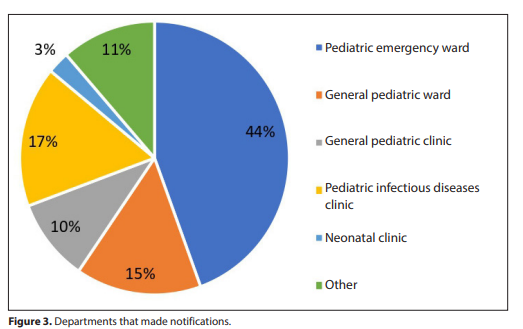
The majority of notifications were reported from the pediatric emergency department, accounting for 168 cases (44%). This was followed by the pediatric infectious diseases clinic with 63 notifications (17%). A total of 57 notifications (15%) were reported from the general pediatrics ward, 37 (10%) from general pediatrics outpatient clinics, and 10 (3%) from the neonatal unit. Additionally, 43 notifications (11%) were reported from other departments, including pediatric surgery, pediatric allergy and immunology, pediatric gastroenterology, and otorhinolaryngology. The distribution of reporting departments is presented in Figure 3.
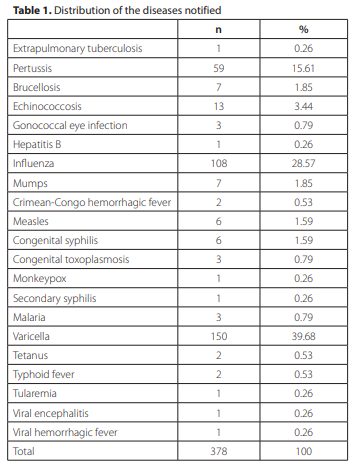
Among all notifications, the most frequently reported disease was varicella (chickenpox), with a total of 150 cases. This was followed by influenza (n= 108) and pertussis (n= 59). Other commonly reported diseases included Echinococcus granulosus infection (n= 13), brucellosis (n= 7), mumps (n= 7), congenital syphilis (n= 6), and measles (n= 6). Less frequently reported diseases included congenital toxoplasmosis,
gonococcal eye infection, tetanus, tularemia, monkeypox, viral encephalitis, viral hemorrhagic fever, and Crimean Congo hemorrhagic fever. All reported diseases are presented in Table 1.
DISCUSSION
Our study, it was determined that notifiable infectious diseases were reported most frequently in 2024, particularly in January; that the pediatric emergency department ranked first among reporting units; and that the most commonly reported disease was varicella. These findings are consistent with other similar studies conducted in our country.
In a study conducted in 2018 at a tertiary pediatric hospital in İzmir evaluating notifiable diseases, varicella was also identified as the most frequently reported disease, followed by pertussis and influenza (6). Similarly, in our study, the most frequently reported diseases were varicella, influenza, and pertussis, respectively. The continued predominance of varicella as the most commonly reported disease in childhood may be related to its easy clinical recognition by pediatricians and the lack of need for laboratory confirmation. Differences in the ranking of pertussis and influenza may be attributed to variations in disease incidence across years or differences in diagnostic laboratory methods used in different centers. In the same study, 10 cases of pulmonary tuberculosis and nine cases of extrapulmonary tuberculosis were reported within one year (6). However, despite covering a five-year period, no pulmonary tuberculosis cases were reported in our study. This may be explained by the lack of a negative-pressure isolation room in our hospital and the inability to adequately isolate patients requiring respiratory precautions, resulting in such cases not being followed in our institution.
Our findings showed that the number of reported notifiable diseases varied over the years, with the lowest levels observed in 2020 and 2021, followed by an increase in 2023 and a peak in 2024. A study conducted in Ankara examining notifiable disease records from 2019 and 2020 similarly reported a significant decrease in case notifications following the onset of the COVID-19 pandemic in 2019 (7). Likewise, in our study, the number of notifications in 2020 and 2021 decreased to approximately one-third of the 2019 levels. This decrease may be associated with community-level infection control measures implemented during the pandemic, which likely reduced the transmission of other infectious diseases as well.
As in Türkiye, many countries maintain surveillance systems for monitoring notifiable infectious diseases. A study conducted in China examining notifiable diseases across all age groups between 2014 and 2020 found that gastrointestinal and enteroviral infections were the most commonly reported, followed by respiratory infections, among which influenza was the most frequent (8). In contrast to our findings, pertussis ranked among the least frequently reported diseases in that study. However, similar to our results, a decline in infectious disease incidence during the pandemic period was also observed due to implemented restrictions (8).
In a pilot study aimed at developing an early warning and response system for diarrheal infectious diseases, it was demonstrated that early reporting enabled the detection of outbreak risk 18 days in advance, allowing timely preventive measures to be implemented (9). This finding highlights the importance of an effective notification system in controlling infectious diseases. In our study, most notifications were made from the emergency department. Similar findings have been reported in the literature, where emergency departments were identified as the primary reporting units (6,10). Therefore, increasing awareness among emergency department teams regarding disease notification may significantly contribute to infectious disease control efforts.
A study evaluating medical students’ knowledge of notifiable infectious diseases found that 79% had insufficient knowledge (11). Another study involving infectious diseases and clinical microbiology specialists and residents reported that 71% of physicians had not received any training on disease notification, 37% did not report cases, and 26% deliberately entered alternative diagnoses to avoid reporting (12). These findings indicate that lack of knowledge regarding disease notification is widespread and that educational efforts should be strengthened. In our study, more than half of all notifications over the five-year period were reported in 2024. This may be related not only to an increase in disease incidence but also to the continuous presence of a pediatric infectious diseases specialist in our hospital during that year, who may have had higher awareness of reporting practices compared to other departments.
Our study, covering a five-year period, provides the opportunity to monitor trends and evaluate changes in notifiable diseases over time. However, its single-center design limits the generalizability of the findings. Additionally, the retrospective nature of the study and the lack of laboratory confirmation in all cases represent important limitations. Nevertheless, this study contributes valuable data to a relatively underrepresented area in the literature focusing on pediatric patients.
CONCLUSION
To improve the effectiveness of infectious disease control, surveillance systems must be continuously updated, healthcare professionals’ awareness of reporting should be strengthened, and laboratory capacities should be expanded. In particular, increasing awareness among pediatric emergency department teams—often the first point of contact for pediatric cases—may play a key role in the early detection of notifiable infectious diseases and the protection of public health. Ethics Committe Approval: This study has been approved by the T.C. İzmir Bakırçay University Non-Interventional Clinical Research Ethics Committee (Decision no: 2060, Date: 19.02.2025). Peer-review: Externally peer-reviewed. Author Contributions: Concept - EK; Design - EK; Supervision - EK; Resource - All of authors; Data Collection and/ or processing - All of authors; Analysis and/or interpretation - All of authors; Literature search - EK, İKC; Writing - EK, İKC; Critical review - EK, ÖO. Conflict of Interest: All authors declare that they have no conflict of interest. Financial Disclosure: The authors declared that this study has recei ved no financial support.