 TR
 EN


ABSTRACT
Objective
Respiratory syncytial virus (RSV) remains a leading cause of lower respiratory tract infections in infants worldwide, with the greatest burden observed in low- and middle-income countries. Maternal vaccination with the RSVpreF vaccine represents a new preventive strategy designed to protect infants through transplacental antibody transfer. This study aimed to evaluate the awareness, knowledge, and attitudes of pregnant women in Türkiye toward RSV infection and maternal RSV vaccination prior to its national introduction.
Materials and Methods
A cross-sectional survey was conducted among 227 pregnant women at Ankara Bilkent City Hospital between August and September 2025. The 30-item questionnaire assessed sociodemographic data, awareness of RSV infection and vaccine, and attitudes toward maternal vaccination.
Results
Only 24.7% of the participants had previously heard of the RSVpreF vaccine, and 68.3% were unaware of RSV transmission routes. Overall, 29.1% expressed willingness to receive the vaccine, 59.5% were undecided, and 11.5% declined. The main reason for refusal was insufficient information (43.5%). In the multivariate logistic regression analysis, three independent predictors were identified: Prior awareness of the RSV vaccine and previous administration of nonroutine vaccines were strong positive predictors of vaccine intention, while being in the third trimester (6–9 months) negatively predicted acceptance.
Conclusion
To date, no published studies have specifically investigated pregnant women’s attitudes toward maternal RSV vaccination in Türkiye. Our findings indicate that acceptance of the RSVpreF vaccine remains limited but could increase substantially if the vaccine were incorporated into the national immunization schedule. Providing clear, evidence-based information about vaccine safety and the protective benefits for infants may significantly enhance maternal confidence and willingness. Future multicenter studies across diverse populations are warranted to evaluate whether comprehensive education of mothers and families regarding RSV infection and vaccination can improve acceptance and ultimately reduce RSV-related morbidity in early infancy.
KEYWORDS
Respiratory syncytial virüs, pregnancy, infant, vaccination
INTRODUCTION
Respiratory Syncytial Virus (RSV) remains a major global public health concern, particularly affecting infants and young children (1). It is one of the principal pathogens responsible for lower respiratory tract infections (LRTIs) during early childhood. Infants are particularly vulnerable during the neonatal period due to relative immune suppression (2). Severe RSV-associated LRTIs predominantly occur within the first two to three months of life, a period when infants are theoretically protected by passively transferred maternal antibodies. This observation highlights the limited duration and effectiveness of naturally acquired maternal immunity against RSV, underscoring the need for enhanced preventive strategies such as maternal vaccination (RSVpreF vaccine) or monoclonal antibody prophylaxis (3). RSV infection follows a well-defined seasonal pattern, with peak incidence typically occurring in colder months; however, regional variations exist. In temperate regions, RSV circulation is highest between November and March, whereas in tropical areas, transmission may persist throughout the year or intensify during the rainy season (1).
Globally, RSV accounts for millions of hospital admissions and approximately 100,000 deaths annually among children under five, with the vast majority occurring in low- and middle-income countries (LMICs) (4). While most infections are self-limiting, the virus poses a considerable burden on healthcare systems. Consequently, passive and active immunization strategies are designed to substantially reduce RSV-associated morbidity and mortality (5). Maternal vaccination facilitates the transplacental transfer of high antibody levels, providing protection to infants immediately after birth.
Although most RSV infections are self-limiting, the virus continues to pose a considerable burden on pediatric healthcare systems, especially in LMICs. Notably, natural infection induces only partial and short-lived immunity, predisposing individuals to reinfection across successive seasons. Consequently, passive and active immunization strategies designed to substantially reduce RSV-associated morbidity and mortality (5). Maternal vaccination leads to transplacental transfer of increased levels of maternal antibodies to provide protection in infants immediately after birth and during months of life.
Until recently, the only licensed preventive measure was palivizumab, limited to high-risk infants. However, a major advancement occurred in 2023 with the FDA approval of nirsevimab, a long-acting monoclonal antibody for universal infant protection (6). Furthermore, the RSVpreF vaccine (Abrysvo) was approved for pregnant women between 32 and 36 weeks of gestation to confer protection during the first six months of an infant’s life (7).
In Türkiye, palivizumab remains the only reimbursed prophylactic agent, available only for specific high-risk groups. Neither nirsevimab nor the RSVpreF vaccine has yet been introduced into national clinical practice. As maternal RSV vaccination programs are being rolled out globally, understanding parental awareness and attitudes is essential for successful implementation (8). Therefore, the present study aims to evaluate the knowledge, perceptions, and intention to receive RSV vaccination among pregnant women at a tertiary maternity hospital in Türkiye. Given that the RSVpreF vaccine is not yet approved in the country, this research provides timely insights into maternal perspectives prior to its potential national introduction.
MATERIALS AND METHODS
This cross-sectional survey study was conducted in the Department of Obstetrics and Gynecology at Ankara Bilkent City Hospital, Ankara, Türkiye. A total of 350 questionnaires were distributed, and 227 pregnant women voluntarily completed the survey. Data collection took place between August and September 2025, prior to the introduction of RSV vaccination programs for pregnant women. The survey was administered through face-to-face interviews. Participation was entirely voluntary, and informed consent was obtained from all respondents before enrollment. Each participant was permitted to complete the questionnaire only once.
The questionnaire was developed by the authors based on a review of the relevant literature to assess vaccine knowledge and attitudes. The Turkish-language form consisted of 30 structured questions divided into three main sections: (1) Sociodemographic and obstetric characteristics: Variables included gestational week, number of children, presence of an infant younger than six months, children’s vaccination status (both within and outside the national immunization schedule), educational attainment, and employment status. (2) Knowledge regarding RSV and the RSVpreF vaccine: Including awareness of RSV infection, recognition of its clinical manifestations, prior knowledge of the RSVpreF vaccine, and history of RSV infection in the family. (3) Attitudes toward RSVpreF vaccination: participants’ willingness to receive the vaccine during pregnancy, reasons for acceptance or refusal, and overall perceptions of vaccine safety and necessity.
Participants who declined or were undecided about vaccination were asked to specify their reasons. Responses were recorded as “yes,” “no,” or “undecided.” The survey did not include questions about seasonal influenza vaccination. Prior to the main study, a pilot test was conducted with 20 pregnant women who were not included in the final sample. The pilot confirmed the questionnaire’s clarity and feasibility, and no modifications were required.
Data analysis was performed using IBM SPSS Statistics for Windows, version 26.0 (IBM Corp., Armonk, NY, USA). Descriptive statistics, including means, standard deviations, medians, ranges, and frequencies, were used to summarize the data. Parametric and nonparametric tests were selected according to data distribution. The chi-square test was applied to compare categorical variables, while independent-samples t-tests or one-way ANOVA were used to assess differences among groups. Statistical significance was defined as p< 0.05. Logistic regression analyses were conducted to explore associations between sociodemographic and attitudinal variables and RSV RSVpreF vaccine acceptance, providing odds ratios (ORs) and 95% confidence intervals (CIs).
The study was conducted in accordance with the principles of the Declaration of Helsinki. This study was approved by the Ankara Bilkent City Hospital No 2 Medical Researches Ethics Committee (Decision no: TABED2-25-1367, Date: 06.08.2025). All participants were informed about the study’s purpose, and written informed consent was obtained prior to their inclusion.
RESULTS
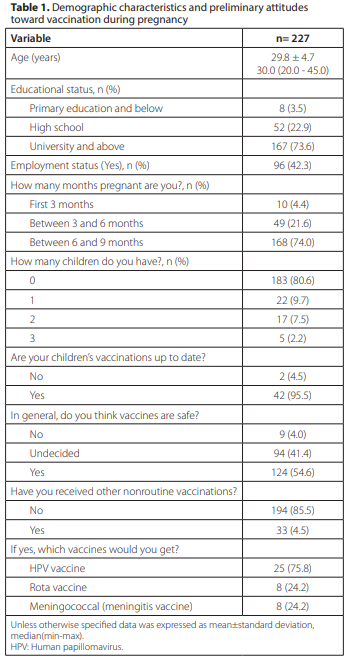
A total of 227 pregnant women participated in and completed the survey. The overall demographic characteristics and preliminary attitudes toward vaccination during pregnancy are summarized in Table 1. The participants’ ages ranged from 20 to 45 years, with a mean (± SD) age of 29.8 ± 4.7 years. The majority of respondents (73.6%) had attained a university-level education or higher, and nearly half (42.3%) were employed at the time of the survey. Most participants (74.0%) were in the third trimester of pregnancy, and a substantial proportion (80.0%) were experiencing their first pregnancy. Among the 44 participants with previous pregnancies, 95.5% reported that their children were fully vaccinated. Regarding perceptions of vaccine safety, 54.6% of the respondents considered vaccines to be safe, 41.4% were undecided, and 4.0% believed vaccines to be unsafe.
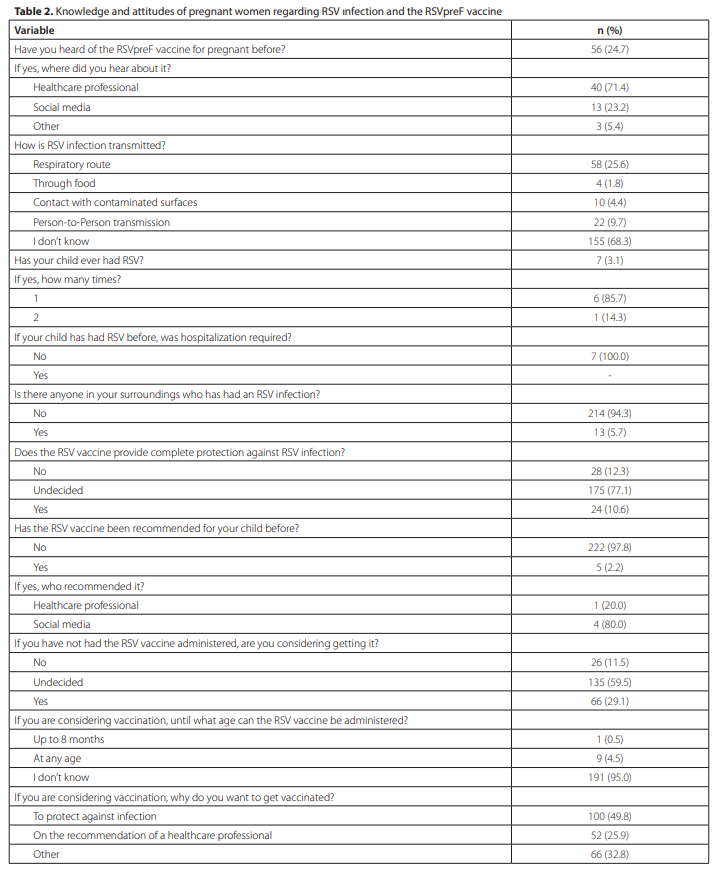
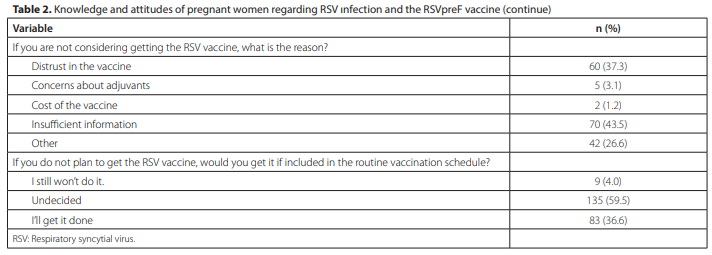
Only a small proportion (24.7%) of pregnant women had previously heard of the RSV vaccine for pregnant women, and the majority of those who had were informed by healthcare professionals (71.4%). Most participants (68.3%) were unaware of the modes of RSV transmission. A total of 3.1% reported that their child had previously been diagnosed with RSV infection; among these, the majority (85.7%) experienced the infection once, and none required hospitalization. The main reasons cited for declining RSV vaccination included insufficient information (43.5%), lack of confidence in vaccine safety (37.3%), concerns regarding adjuvants (3.1%), and the cost of the vaccine (2.1%), respectively (Table 2).
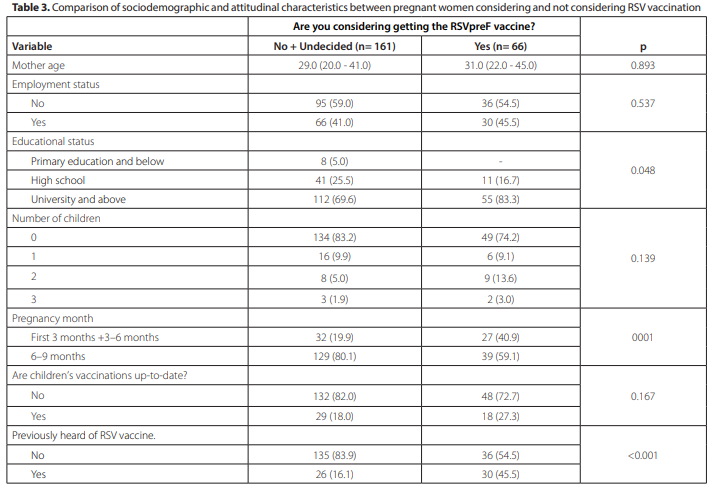
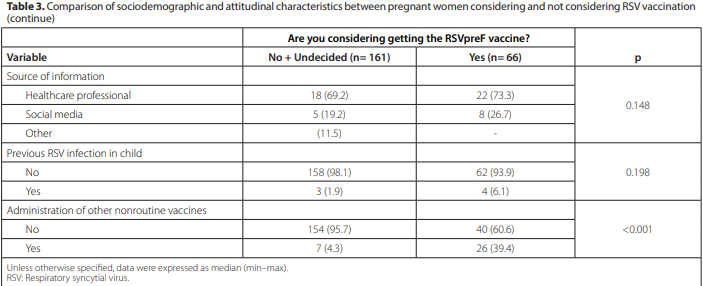
Participants who were undecided or unwilling to get the RSV vaccine were combined into a single group (n= 161) and compared with those who expressed willingness to be vaccinated (n= 66); the results are summarized in Table 3. The analysis revealed that participants intending to receive the RSV vaccine had significantly higher educational status (p= 0.048). Those in the third trimester were more likely to be undecided about RSV vaccination (p< 0.001). Prior awareness of the RSV vaccine was strongly associated with an increased intention to receive RSV vaccinated (p< 0.001). In addition, participants who had previously received other nonroutine vaccines demonstrated a significantly higher proportion of intending to receive the RSV vaccine (p< 0.001).
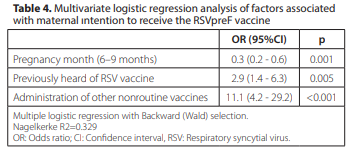
In the multiple logistic regression analysis, two factors independently predicted a positive intention toward RSV vaccine: Previously heard of RSV vaccine (OR = 2.9; 95% CI: 1.4-6.3; p= 0.005) and administration of other nonroutine vaccines (OR= 11.1; 95% CI: 4.2-29.2; p< 0.001) and one factor independently predicted a negative intention toward RSV vaccine: Pregnancy month (6–9 months) (OR= 0.3; 95% CI: 0.2 - 0.6; p= 0.001) (Table 4).
DISCUSSION
Immunization remains one of the greatest achievements in modern public health, drastically reducing the burden of infectious diseases worldwide. Maternal vaccination, in particular, provides a dual layer of protection—safeguarding both mother and infant—by enabling transplacental transfer of antibodies and antibody secretion through breastfeeding. To our knowledge, this study is the first in Türkiye to evaluate pregnant women’s awareness, perceptions, and willingness to receive a potential RSV vaccine during pregnancy.
Studies from high-income countries demonstrate that despite limited awareness about RSV infection itself, the acceptance rate of maternal RSV vaccination is relatively high. In surveys conducted in Austria and the United Kingdom, approximately 83–88% of participants had not previously heard of RSV, yet vaccine acceptance reached 75–77% (9,10). Similarly, an Irish study reported a 48% acceptance rate, with an additional 45% of participants undecided (11). Collectively, these studies indicate a favorable tendency toward maternal RSV vaccination in developed settings. In our cohort, however, only 31.7% of pregnant women correctly identified RSV transmission routes, while 68.3% reported no knowledge on the subject. Moreover, 94.3% had never encountered anyone diagnosed with RSV infection. This low level of familiarity may not necessarily reflect a lack of general health awareness. One possible explanation is the broader change in public exposure to and attention toward respiratory viral infections during and after the Coronavirus Disease 2019 (COVID-19) pandemic. However, since this study did not directly assess the reasons for limited RSV awareness, this interpretation should be considered speculative.
Despite this, nearly one in four respondents (24.7%) indicated prior awareness of the RSV vaccine. When asked about their willingness to receive it once available, 29.1% expressed readiness, while 59.5% remained undecided. These findings align with the early stages of vaccine introduction in other countries, where uncertainty and hesitation are common prior to widespread health education campaigns.
Consistent with prior studies, maternal age and parity were not significant predictors of vaccine acceptance (9,11). Likewise, healthcare professionals were regarded as the most reliable source of vaccine-related information (10,12,13). However, our findings reveal an interesting shift in the modern information landscape. Although most participants initially learned about the RSV vaccine from healthcare workers, the majority reported first encountering vaccine recommendations via social media platforms. This underscores the growing influence of digital media on public health perceptions. Given the increasing reach of online platforms, integrating evidence-based, health-professional-endorsed content into social media campaigns could substantially enhance vaccine literacy and confidence—particularly in LMICs, where access to healthcare professionals may be limited.
Pregnant women may also hesitate to receive vaccines during pregnancy due to concerns that potential adverse effects could harm the fetus (14). Furthermore, limited perception of the severity of RSV infection in unborn or newborn infants may contribute to uncertainty and vaccine hesitancy. In a previous study conducted at our center evaluating maternal willingness for infant nirsevimab administration, 50% of pregnant women indicated that they would agree to receive the monoclonal antibody (nirsevimab) administration for their infants (15). However, in the present study, the acceptance rate for RSVpreF, maternal vaccination during pregnancy was lower. This difference may be attributed to the perception that a vaccine administered during pregnancy could have adverse effects on the unborn fetus, leading to greater caution among expectant mothers.
Furthermore, from a broader public health perspective, maternal RSV immunization and infant monoclonal antibody strategies—such as nirsevimab—should be viewed as synergistic rather than mutually exclusive. While maternal vaccination leverages transplacental antibody transfer to provide immediate protection from birth, long-acting monoclonal antibodies offer a direct, high-potency alternative that remains effective regardless of maternal immune response or gestational age at birth (6,16). Integrating both strategies within a comprehensive RSV prevention framework could maximize population-level protection, particularly in clinical scenarios where maternal vaccine uptake is suboptimal or where late-presenting antenatal care limits the window for effective immunization. Such a dual-track approach is increasingly recognized in global health policies as a pragmatic solution to alleviate the substantial burden of RSV-related LRTIs in early infancy (17).
Common barriers to maternal immunization identified in the literature include concerns about vaccine safety during pregnancy, insufficient information, and limited understanding of RSV disease severity in infants (18,19). These themes were echoed in our study: among participants who declined or were hesitant about vaccination, 43.5% cited inadequate information, and 37.3% reported distrust in the vaccine. Such responses highlight the central role of clear, consistent, and credible health communication in shaping vaccine attitudes.
Overall, the results emphasize that improving maternal awareness and trust through targeted educational interventions—particularly those leveraging both healthcare provider engagement and digital communication—will be essential for successful implementation of maternal RSV vaccination programs in Türkiye.
In the multivariate analysis, prior awareness of the RSV vaccine and a history of receiving nonroutine vaccines emerged as independent predictors of positive vaccine intention, while being in the later stages of pregnancy (6–9 months) was associated with lower willingness to receive the RSV vaccine. Participants who had previously heard about the RSV vaccine were nearly three times more likely to express acceptance, highlighting the pivotal role of baseline knowledge in shaping maternal vaccine decisions. Likewise, women who had previously received vaccines outside the standard immunization schedule were over eleven times more likely to report a positive attitude, suggesting that general vaccine confidence and prior positive vaccination experiences substantially enhance openness toward new immunization strategies.
Conversely, advancing gestational age was a strong negative predictor, indicating that pregnant women in the third trimester may become increasingly hesitant. This finding is particularly noteworthy, as maternal RSV vaccination is recommended between 32 and 36 weeks of gestation. One possible explanation is that risk perception intensifies in late pregnancy, with women becoming more concerned about potential fetal harm as delivery approaches. In addition, insufficient counseling during earlier antenatal visits may contribute to uncertainty or delayed decision-making, especially if information about vaccination is not introduced in the first or second trimester. Misunderstanding regarding the recommended timing of vaccination may also play a role, leading some women to perceive late pregnancy as an inappropriate or unsafe period for immunization. This trend could reflect heightened concern about potential fetal risks as pregnancy progresses, a pattern consistent with previous studies on maternal vaccination behavior. Indeed, gestational age has been identified as a factor associated with vaccine hesitancy, alongside knowledge and educational status in pregnant populations (20). Furthermore, safety concerns, lack of knowledge, and absence of clear healthcare provider recommendations are among the most commonly reported barriers to maternal vaccination acceptance globally (21).
These findings collectively emphasize the importance of early antenatal education on RSV prevention and the need for healthcare professionals to initiate vaccine counseling during the first or second trimester, when maternal receptivity may be greater. Understanding expectant mothers’ awareness and acceptance of RSV prevention measures is vital for informing future immunization strategies. Since LMICs experience the greatest burden of RSV-related illness and mortality, integrating affordable and sustainable preventive programs into national healthcare systems is crucial to reducing its impact on infant health. The findings of this study offer valuable perspectives on both the barriers and the opportunities surrounding RSV prophylaxis in resource-constrained settings, underscoring the importance of ensuring equitable access to effective, life-saving interventions. Data from geographically and regionally relevant settings remain limited.
However, recent studies from Greece have shown that maternal awareness and acceptance of RSV vaccination are influenced by prior knowledge, perceived infant benefit, and trust in healthcare recommendations. Similarly, research from Jordan and broader Middle Eastern settings suggests that vaccine confidence, trust in health authorities, and concern about infant RSV disease are key determinants of maternal acceptance. In addition, studies from Kenya have emphasized that maternal RSV vaccine acceptance is shaped by trust in healthcare providers, social norms, community sensitization, and clear communication about vaccine safety and infant benefit. In this context, our findings from Türkiye are broadly consistent with evidence from nearby and other middle-income settings, particularly regarding the importance of reliable information and trust in shaping maternal willingness toward RSV immunization (22–25).
Limitations
Our study has several limitations that warrant consideration. First, the data were collected from a single tertiary care center, which may not fully represent the socio-demographic diversity of the general pregnant population in Türkiye. In particular, the proportion of participants with university-level education was high, potentially influencing baseline vaccine awareness and literacy. Furthermore, our cohort exhibited a specific obstetric profile; 80.0% were primiparous (experiencing their first pregnancy) and 74.0% were in their third trimester. This distribution may introduce a selection bias, as first-time mothers may have different risk perceptions compared to multiparous women. Additionally, since our findings indicated that advancing gestational age is an independent predictor of lower vaccine willingness, the high concentration of participants in late pregnancy may have skewed the overall acceptance rates downward. These factors limit the external validity of our findings, and the results should be generalized with caution. Lastly, while the questionnaire focused on the maternal RSVpreF vaccine, it did not comprehensively assess postnatal attitudes toward long-acting monoclonal antibodies such as nirsevimab, which remains an area for future research.
Strengths
Despite these limitations, this study provides important baseline data on maternal knowledge and perceptions of RSV and RSVpreF vaccination in Türkiye. Pregnant women represent a critical population for preventive health strategies, and assessing their attitudes offers valuable insight for future maternal immunization programs. Furthermore, this study is among the first in the country to explore vaccine hesitancy and awareness before the official introduction of RSV maternal vaccination, offering guidance for national education and communication strategies aimed at improving vaccine acceptance.
CONCLUSION
This study provides one of the first insights into maternal awareness and attitudes toward RSV and the newly developed RSVpreF vaccine among pregnant women in Türkiye. Although general awareness of RSV infection was limited, a substantial proportion of participants expressed openness to maternal immunization, indicating potential readiness for future vaccination programs once the vaccine becomes available nationally. Prior knowledge of the RSV vaccine and previous acceptance of nonroutine vaccines were strong predictors of willingness, whereas advancing gestational age was associated with greater hesitancy. These findings highlight the critical importance of early antenatal education and targeted communication strategies to enhance maternal understanding and trust.
Integrating accurate, evidence-based information about RSV prevention into routine prenatal counseling—supported by both healthcare professionals and reliable digital media— will be essential for improving vaccine confidence. As RSV immunization becomes globally implemented, understanding maternal perspectives will play a pivotal role in guiding public health planning and ensuring equitable access to preventive interventions that protect the most vulnerable infants.