
 TR
 EN


INTRODUCTION
Question 1: What is the optimal timing for infants and young children to receive an antibody product for protection against respiratory syncytial virus (RSV)?
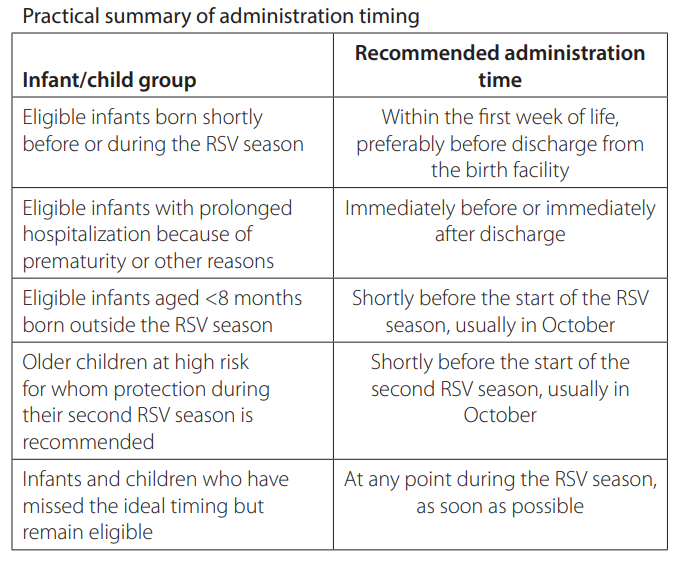
Nirsevimab (Beyfortus, Sanofi) should ideally be administered within the first week of life to infants born shortly before or during the RSV season. Although the RSV season generally covers the November–March period in our country, it may vary according to regional epidemiological characteristics.
The ideal approach is to administer nirsevimab to all infants, including premature infants, before discharge from the birth facility. This ensures that protective antibody levels are established before the infant begins to face the possibility of exposure to RSV in the community.
Infants who require prolonged hospitalization after birth because of prematurity or other reasons and who are eligible for nirsevimab should receive it immediately before hospital discharge or as soon as possible after discharge. Particularly in infants who have been monitored in the neonatal intensive care unit for an extended period, it is important to ensure protection before RSV exposure begins after discharge.
If infants younger than 8 months who were born outside the RSV season require protection with nirsevimab, administration should ideally take place shortly before the start of the RSV season. In general, this period corresponds to approximately October–November.
Similarly, older children who are at high risk of RSV infection and for whom protection during their second RSV season is recommended should ideally receive nirsevimab shortly before the start of the RSV season.
What should be done if the recommended administration time has been missed?
Even if the ideal administration time has been missed, infants and children who are age-eligible for nirsevimab and have not yet received a dose may receive protection at any point during the RSV season.
Therefore, failure to administer nirsevimab at the recommended time does not eliminate the opportunity for the infant or child to receive a protective antibody during the remainder of the RSV season. Children who meet the eligibility criteria and have not yet received a dose should receive nirsevimab as soon as possible while the RSV season is ongoing.
Question 2: Storage, transport, and cold chain conditions for nirsevimab
Nirsevimab (Beyfortus, Sanofi) is a long-acting RSV monoclonal antibody used to prevent lower respiratory tract disease caused by RSV infection, particularly in infants. Although nirsevimab is not a vaccine in the conventional sense, it is subject to cold chain requirements similar to those of vaccines in many immunization programs with respect to administration and storage.
Nirsevimab is supplied as a ready-to-use, single-dose manufacturer-filled syringe (MFS). The product is available in two different doses: 50 mg and 100 mg.
Storing, transporting, and administering the preparation under appropriate temperature conditions is important for preserving its physical and biological properties.
• Recommended storage temperature: The primary storage condition for nirsevimab is refrigeration at 2 °C–8 °C. The product should be stored in a reliable refrigerator for medical products/vaccines that maintains the recommended temperature range. During storage, the product should be protected from temperature fluctuations as much as possible.
It is recommended that nirsevimab: Be stored at 2 °C–8 °C, not be frozen, not be exposed to excessive heat, be protected from direct sunlight, and be kept in its original carton until use.
Retaining the original packaging is important not only for physical protection but also for easy verification of the product’s identity, expiration date, and batch/lot information.
• Protection from light: Nirsevimab should be stored in its original carton and protected from light until use. Therefore, the product should not be kept unpackaged in the refrigerator in a location where it may be exposed to direct light. Before administration, the product should be removed from its packaging and prepared as close to the time of administration as possible.
• Do not freeze: The physical and structural properties of monoclonal antibodies may be affected by freezing and thawing. Therefore, exposure of the product to freezing conditions requires assessment in terms of quality and efficacy, even if its appearance is normal.
If nirsevimab is known or suspected to have been accidentally frozen, it is preferable not to use it.
• Storage at room temperature: When necessary, nirsevimab may be kept at a room temperature of 20 °C–25 °C for a maximum of 8 hours after removal from the refrigerator. This feature is particularly important in situations where the product needs to be removed from refrigeration for a short period at administration centers. After removal from the refrigerator, total exposure to room temperature must not exceed 8 hours. Any product not used within 8 hours must be discarded.
• Points to consider during transport: When nirsevimab needs to be transported from one center to another, care should be taken to maintain the recommended temperature conditions. During transport, the product should not be exposed to direct sunlight, should be protected from high temperatures, should be transported under appropriate conditions to prevent freezing, should remain in its original packaging, and should be transported in as short a time as possible. In particular, direct contact between ice packs and the product should be appropriately prevented, as this may cause the product to freeze.
Question 3: Does administration of hepatitis B immune globulin (HBIG) at birth affect the recommended timing of the antibody product for protection against RSV?
No. A clinically significant interaction is not expected between HBIG administered at birth and the antibody preparation used for protection against RSV infection.
Therefore, administration of HBIG at birth is not a reason to delay or change the recommended timing of the protective antibody against RSV.
Nirsevimab (Beyfortus, Sanofi) should be administered in accordance with current recommendations.
In other words, even if a newborn has received HBIG at birth, no specific waiting period is required before nirsevimab administration. Both antibody preparations may be administered according to their respective clinical indications and recommended timing.
This approach is particularly important for newborns born at the beginning of the RSV season. Planning HBIG administration and nirsevimab administration independently prevents unnecessary delays in protection against RSV.