
 TR
 EN


INTRODUCTION
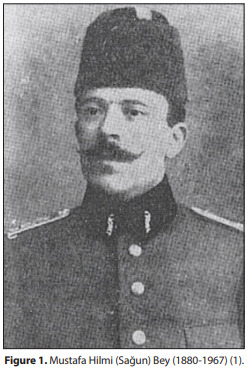
The period extending from the late nineteenth century to the early years of the Republic represents an important process of transformation in Turkish medicine, during which bacteriology developed and the fight against epidemic diseases, vaccine production, and preventive health services gradually acquired an institutional character. One of the prominent physicians of this period, Dr. Mustafa Hilmi (Sağun) Bey, fought against infectious diseases and conducted studies on vaccine production throughout his professional career, which began at Gülhane; he also assumed important responsibilities in the development of the institutes of hygiene in Sivas and Ankara. The professional life of Dr. Mustafa Hilmi (Sağun) Bey reflects not only the individual work of a bacteriologist but also the development of preventive health services from the Ottoman Empire to the Republic. Therefore, examining his medical education and the process of his specialisation in bacteriology is also instructive for understanding how this transformation took place.
The process that brought Mustafa Hilmi Bey to this point began in 1880 in the village of Sarlıca on the island of Lesbos, which was then within the borders of the Ottoman Empire. After completing his primary education on Lesbos, he entered the Istanbul Medical Preparatory School in 1896 and subsequently continued his education at the Imperial Military School of Medicine. Dr. Elhaç Rıza Tahsin (Gençer) described him as “one of our young and distinguished physicians who is constantly engaged in diligent work and scholarly research”; in other words, he emphasised that he was one of our young and distinguished physicians who worked continuously and conducted research (2).1 Having successfully completed his education at the School of Medicine, Dr. Mustafa Hilmi (Sağun) Bey graduated on 4 November 1905 with the rank of medical captain together with his classmates Dr. İbrahim Refik (Saydam)2 , Dr. Rüştü Recep (Duyar)3 , and Dr. Hüsamettin Şerif (Kural)4 (1,7).
Following his graduation, Dr. Mustafa Hilmi Bey served for four years with Dr. Reşat Rıza (Kor) as an assistant to Dr. Georg Deycke at the Gülhane Clinical Hospital and School of Practice (8)5 . Although he was appointed to Gümüşsuyu Military Hospital on 23 March 1909, he returned to Gülhane the following year and was appointed Assistant Lecturer in Internal Medicine Microscopy and Chemistry. He subsequently managed the internal medicine clinic for a period after Dr. Süleyman Numan Pasha had left Gülhane (1). During this period, he came to prominence through his work in bacteriology and, particularly after diagnosing cholera in suspected cases observed in Istanbul, was appointed Head of Bacteriology upon the recommendation of Dr. Julius Wieting Pasha6 , Director of the Gülhane Clinical Hospital and School of Practice (7,11).
During his tenure as Head of Bacteriology, Dr. Mustafa Hilmi (Sağun) Bey conducted studies on typhoid, cholera, typhus, dysentery, and plague vaccines together with Dr. Reşat Rıza (Kor) Bey, with the encouragement of Dr. Wieting Pasha, Director of the Gülhane Clinical Hospital and School of Practice (12,13). As part of these studies, they prepared a typhoid vaccine with a reduced bacterial concentration, an inactivated cholera vaccine, and a dysentery vaccine containing nine different paradysentery bacilli. In addition, together with Dr. Reşat Rıza (Kor) Bey, they prepared the world’s first typhus vaccine and cultivated Leishmania tropica (14-16).7
1 Dr. Elhaç Rıza Tahsin (Gençer) (1871-1950) was born in Batumi. He graduated from the Imperial School of Medicine in 1891 with the rank of medical captain and subsequently served as Assistant Lecturer in Bacteriology at the School of Medicine. After serving in various regions of Anatolia during the First World War, he was appointed to Gümüşsuyu Military Hospital in Istanbul. He retired from military service in 1917 and later practised medicine at Amasya State Hospital and the State Railways. He died on 16 March 1950. One of our country’s first medical historians, Dr. Elhaç Rıza Tahsin (Gençer), addressed the history of medicine from the Süleymaniye School of Medicine to the Haydarpaşa Faculty of Medicine in his work Mirat-ı Mekteb-i Tıbbiye, first published in 1904, and also included the names and brief biographies of physicians and pharmacists who graduated from the School of Medicine after 1843 (3).
2 Dr. İbrahim Refik (Saydam) (1881-1942) was born in Istanbul in 1881, entered Fatih Military Secondary School in 1892, and transferred to the Military Medical Preparatory School in 1896. After graduating with the rank of medical captain in 1905, he began working in the Histology and Embryology Department of the Gülhane Clinical Hospital and School of Practice in 1907. In 1908, he served at the Third Army Central Hospital in Manastır and was subsequently appointed to Maltepe Military Hospital. In 1910, he passed the examinations held for interns to be sent abroad and was sent to Germany by order of Minister of War Mahmut Şevket Pasha. There, he trained at the Berlin Military Medical Academy and with the Sixth Armoured Cavalry Regiment in Brandenburg, subsequently served at military field medical facilities in Danzig, and attended military medical courses in Spandau. With the outbreak of the Balkan War, he returned to Istanbul in 1912 and served on commissions affiliated with the Headquarters of the 18th Army Corps, the Hadımköy Station Dispatch Medical Office, and the Çatalca Army Medical Inspectorate. On 6 January 1914, he was appointed Assistant to the Medical Department of the Ministry of War; with the outbreak of the First World War, he was appointed Assistant to the General Inspectorate of Field Medical Services. He travelled to Germany again on 22 March 1916 and then proceeded to Galicia to inspect the medical organisation on the Galician Front. He landed in Samsun with Mustafa Kemal (Atatürk) on 19 May 1919 and travelled successively to Samsun, Havza, Amasya, Sivas, and Erzurum; when Mustafa Kemal resigned from military service in July 1919, he also resigned. He was one of the 115 deputies able to attend the opening of the Grand National Assembly of Türkiye in Ankara on 23 April 1920. He was appointed Minister of Health and Social Assistance on 10 March 1921 and remained in this post until 26 October 1937. He became Prime Minister on 25 October 1939 and died of a heart attack on 8 July 1942 (4).
3 Dr. Rüştü Recep (Duyar) (1885-1967) was born in Istanbul in 1885. After completing his primary, secondary, and high-school education in Istanbul, he entered the Imperial School of Medicine and graduated in 1905. Following his graduation, he began serving as an assistant in Neurology and Psychiatry at the Gülhane Clinical Hospital and School of Practice and completed his specialisation. During the First World War, he served at Edirne Military Hospital and was subsequently appointed to Haydarpaşa Military Hospital. After serving for a period as Deputy Director of Neurology and Psychiatry at the Faculty of Medicine in Haydarpaşa, he became Chief Physician of Bakırköy Hospital for Mental and Neurological Diseases. In 1943, he served as a neurology specialist at Şişli Etfal (Children’s) Hospital and died on 10 April 1967 (5,6).
4 Dr. Hüsamettin Şerif (Kural) (1879-1945) was born in Konya in 1879. He graduated from the Imperial School of Medicine in 1905 with the rank of medical captain and was sent to the Val-de-Grâce Military Medical School in France in 1909 for specialist training. After two years of education, he attended courses at the Pasteur Institute. Following his return to the country, he directed the Infectious Diseases and Bacteriology services at Yıldız Hospital in 1914 and later at Kuleli Military Hospital. He succeeded Dr. Mustafa Hilmi (Sağun) Bey as lecturer in bacteriology at Gülhane. When Gülhane was occupied by the French during the Armistice period, he worked at Gümüşsuyu Military Hospital until 1921 and was appointed bacteriologist at Ankara Central Hospital in the same year. He resigned from this post in 1923 and died in 1945 (1).
5 Prof. Dr. Franz B. Georg Deycke (1865-1938) came to Istanbul in 1898 at the invitation of the Ottoman Empire and served at Gülhane until 1907, principally in microbiology but also in the internal medicine and dermatology clinics. Together with Dr. Robert Rieder, he founded the Gülhane Clinical Hospital and School of Practice on 30 December 1898 and served as its director from 1904 to 1907 (8,9).
6 Dr. Julius Wieting (1868-1922) received his medical doctorate from the University of Marburg in 1898 with his thesis entitled “Über Meningomyelitis mit besonderer Berücksichtigung der Meningomyelitis Cervicalis Chronica” (On Meningomyelitis: A Study with Particular Reference to Chronic Cervical Meningomyelitis). Following Dr. Robert Rieder and Dr. Georg Deycke, he was appointed director of the Gülhane Clinical Hospital and School of Practice in 1907. During Dr. Julius Wieting’s tenure, scientific research at Gülhane was conducted concurrently with theoretical and practical education. Scientific meetings attended by prominent physicians, known as Gülhane Seririyatı, began to be held at Gülhane for the first time. He returned to Germany in 1914 and died in 1922 (10).
7 For more detailed information on Dr. Reşat Rıza (Kor) and the typhus vaccine, see (16).
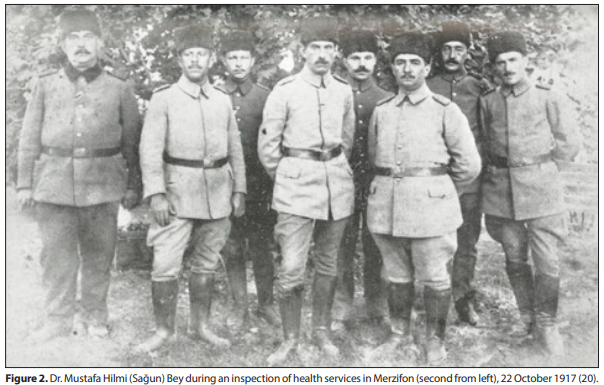
In the dysentery vaccine prepared by Dr. Mustafa Hilmi (Sağun) Bey and Dr. Reşat Rıza (Kor) Bey, cultures obtained from different types of dysentery bacteria were suspended in physiological saline and heated at 57 °C for one hour. Phenol at a concentration of 0.5% was then added to the mixture. The prepared vaccine was tested in certain military units and hospitals and was found suitable for use (17). Dr. Mustafa Hilmi (Sağun) Bey, who made significant contributions to protecting the army from epidemic diseases, was awarded the Silver Medal of Merit and the War Medal for these studies (7,18,19).
Dr. Mustafa Hilmi Bey, who continued his work at the Gülhane Clinical Hospital and School of Practice until 8 August 1917, was appointed bacteriologist of the Third Army on that date. During the First World War, he also served as a bacteriologist at the İplikhane and Selimiye hospitals and the Beşiktaş Dispensary (1,7,21). In 1920, particularly after the plague epidemic in Istanbul intensified and it became clear that the demand for vaccines could not be met with the available resources, Dr. Mustafa Hilmi Bey converted the Gedikpaşa Bath into a laboratory, where he prepared plague vaccine in boza bottles together with Dr. Kâzım (Lakay)8 and Dr. Cevdet (Kapandadik) (22-24).
Appointed Head of Bacteriology at Haydarpaşa Military Hospital in October 1920, Dr. Mustafa Hilmi Bey left military service at his own request on 30 January 1921 and transferred to the Ministry of Health and Social Assistance (today’s Ministry of Health) (7). While continuing his service at the Ministry, he was appointed Director of the Sivas Institute of Hygiene, one of Anatolia’s leading health centres, on 5 December 1922 (25). The importance of the institution is also evident from the following words in Mustafa Kemal Pasha’s speech at the opening of the Fourth Legislative Year of the First Term of the Grand National Assembly of Türkiye on 1 March 1923:
“During 1921, the Sivas Institution, which was capable of producing smallpox vaccine for three million people, produced smallpox vaccine for five million people, 537 kilograms of cholera vaccine, and 477 kilograms of typhoid vaccine during the past year, and these were administered adequately to the public. A third institute of hygiene, each consisting of a bacteriology laboratory, a chemistry laboratory, a vaccine station, and a rabies treatment centre, in addition to those currently located in Istanbul and Sivas, will be established in Diyarbakır this year, thereby eliminating the inconveniences arising from patients having to travel to distant places.” (26-27).
8 Dr. Kâzım (Lakay) was born in İzmit in 1888. After graduating from the Military School of Medicine in 1913, he completed his internship in the Infectious Diseases and Bacteriology Branch of the Gülhane Clinical Hospital and School of Practice. With the outbreak of the First World War, he was assigned to Erzurum and also fought the cholera epidemic that emerged in Bitlis during this period. After the war, he returned to his post at Gülhane; in 1920, he joined the War of Independence and assumed the directorship of the Gülhane Medical Supplies Manufacturing and Vaccine Preparations Branch. He was awarded various decorations and medals for his services in the Balkan War, the First World War, and the War of Independence and retired from military service in 1923. After his retirement, he worked at the Tuberculosis Control Dispensary in Istanbul and was appointed Chief Physician of Haydarpaşa Numune Hospital in 1936. He served as president of the Red Crescent Society for ten years and died in 1971 (5).
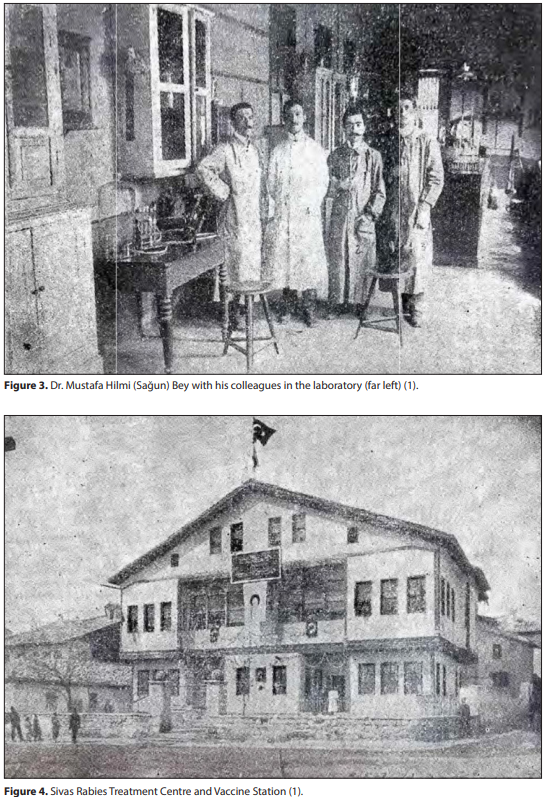
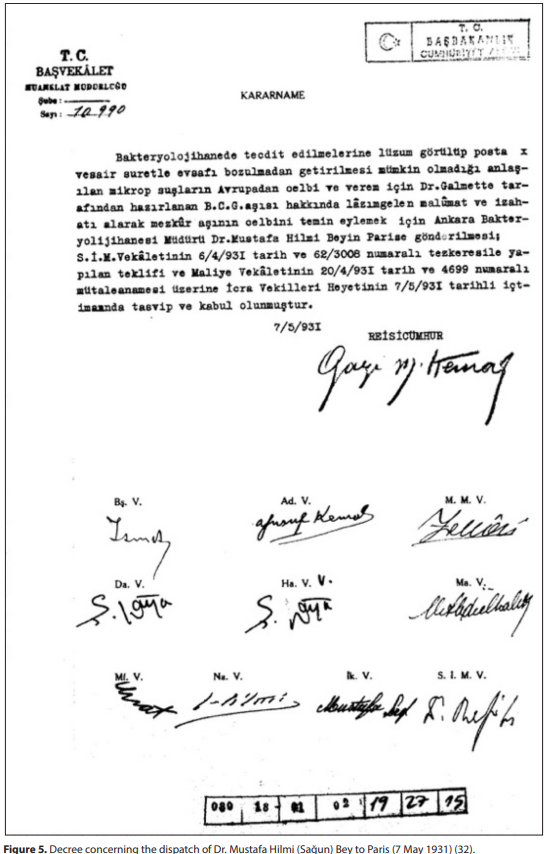
While serving as director of the institution, which consisted of a bacteriology and chemistry laboratory, a vaccine station, and a rabies treatment centre, Dr. Mustafa Hilmi Bey conducted intensive work both on vaccine production and on combating infectious diseases. Furthermore, following the establishment of the Republic, preparations began for a series of works entitled The Sanitary and Social Geography of Türkiye, with the aim of identifying the historical, geographical, health-related, climatic, and cultural characteristics of the provinces (28). Within the scope of this project, Dr. Mustafa Hilmi Bey, Director of the Sivas Institute of Hygiene, made significant contributions to the preparation of the comprehensive report entitled The Sanitary and Social Geography of Sivas Province (29).
In February 1926, Dr. Mustafa Hilmi Bey was sent by the Ministry of Health and Social Assistance to the Pasteur Institute in Paris for six months to receive training in serology and vaccines. After completing his training, he returned to the country and continued as Director of the Sivas Institute of Hygiene (1,7). During the years in which he continued his service in Sivas, the Central Institute of Hygiene was established in 1928 as part of efforts to bring preventive health services together under a central structure. The institution was organised into four branches: Chemical Analysis, Bacteriology, Immunobiology (vaccines and serums), and Pharmacodynamics (pharmacology); the Chemical Analysis Branch was the first to commence operations that same year. The bacteriology institutes in Istanbul and Sivas were also transferred to Ankara in 1929 and merged within the institution under the name Ankara Bacteriology Institute. This new unit continued its work under the direction of Dr. Mustafa Hilmi Bey (30-31).
While serving as Director of the Ankara Bacteriology Institute, Dr. Mustafa Hilmi Bey was sent to Paris for the second time in 1931 in order to obtain from Europe the microbial strains that needed to be renewed at the institute and to acquire the necessary information about the BCG vaccine developed by Dr. Albert Calmette, thereby facilitating the vaccine’s introduction into Türkiye (32).
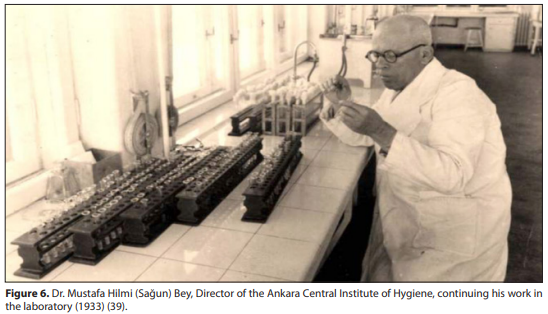
Shortly after his return from Paris, the Ankara Bacteriology Institute was closed and the Bacteriology Branch of the Central Institute of Hygiene9 commenced operations, while Dr. Mustafa Hilmi Bey was appointed the first director of the Central Institute of Hygiene in 1932. During his directorship, he established the first BCG laboratory within the institution and initiated BCG vaccine production (34-36).
Furthermore, on 1 June 1932, he established the Rabies Laboratory within the institution and personally prepared the Semple-type rabies vaccine there. With the vaccines produced being sent to rabies treatment stations from 1933 onwards, a decentralised system was adopted for rabies vaccination. Formulations containing 2% sheep brain between 1932 and 1934, 3% in 1935, and 5% from 1945 onwards were used in vaccine production (37,38).
While these studies continued, the organisational structure of the institution also continued to expand. In addition
9 Following the death on 8 July 1942 of Dr. Refik Saydam, who had pioneered the establishment of the Central Institute of Hygiene, the institution’s name was changed to the “Refik Saydam Central Institute of Hygiene of the Republic of Türkiye” under Law No. 4288, adopted on 10 August 1942, in order to perpetuate his memory. See (33).
to the Chemical Analysis and Bacteriology branches, the Immunobiology Branch commenced operations in 1935 and the Pharmacodynamics Branch in 1936. The Central Institute of Hygiene thus assumed an important role in the development of preventive health services in Türkiye (34). After handing over the directorship of the institution in 1935 to Prof. Dr. Emil Gotschlich,10 who was of German origin, Dr. Mustafa Hilmi (Sağun) Bey assumed the directorship of the Bacteriology Branch (24,41).
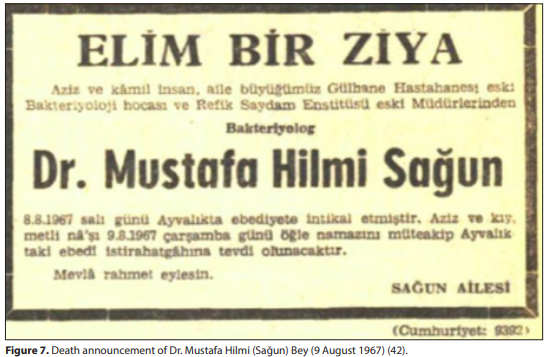
Dr. Mustafa Hilmi (Sağun) Bey continued his work at the Central Institute of Hygiene until 1937 and retired that same year. After his retirement, Dr. Mustafa Hilmi Bey devoted more time to his family, and both of his sons chose the medical profession. Surgeon Dr. Nejat Sağun practised in Istanbul, while Dr. Yalçın Sağun practised in Ayvalık (2). Dr. Mustafa Hilmi (Sağun) Bey died on 8 August 1967 at the age of 87 and was buried in the family cemetery in Ayvalık (7).
The professional life of Dr. Mustafa Hilmi (Sağun) Bey stands as a concrete example of the institutional transformation that took place in the fields of combating infectious diseases and vaccine production during the period extending from the Ottoman Empire to the Republic. He continued the bacteriological studies he had begun at Gülhane under the supervision of Dr. Franz B. Georg Deycke and Dr. Julius Wieting by combining his scientific knowledge with practical solutions under the severe epidemic conditions of the First World War. The responsibilities he assumed in the organisation of the institutes of hygiene in Sivas and Ankara during the Republican period clearly demonstrate that he was not only a bacteriologist but also one of the figures who shaped the institutionalisation of preventive health services in Türkiye. The BCG and Rabies laboratories he established as the first director of the Central Institute of Hygiene made significant contributions to the development of vaccine production in our country. His continuation of his work within the institution as Director of the Bacteriology Branch after handing over the institution’s directorship to Prof. Dr. Emil Gotschlich in 1935 may also be regarded as a reflection of Turkish-German scientific cooperation during the period. The life story of Dr. Mustafa Hilmi (Sağun) Bey is one of the noteworthy examples in our medical history of how a physician could transform his professional knowledge and experience into a lasting institutional legacy and pass it on to subsequent generations.
10 Dr. Emil Gotschlich (1870-1949) was born in Beuthen in 1870. He began his medical education in Breslau in 1889 and graduated in 1894. After working for a period under Dr. Carl Flügge at the Institute of Hygiene of the University of Breslau, he was sent in 1896, at the request of Dr. Robert Koch, to serve as director of the Alexandria Municipal Health Department. While serving in Egypt, he fought the plague epidemic in 1899 and the cholera epidemic in 1902, and, together with his brother Dr. Felix Gotschlich, contributed to the health regulations for Hajj caravans. He held this post until the First World War and represented Egypt on the International Sanitary and Quarantine Council. Upon returning to Germany in 1915, he worked at the Institutes of Hygiene in Halle and Saarbrücken. He began working at the Chair of Hygiene at the University of Gießen in 1917 and transferred to Heidelberg University in 1926. Prof. Dr. Emil Gotschlich retired in 1935, was appointed Director of the Central Institute of Hygiene in Ankara, and held this position until 1941. He was also the founder of the Turkish Bulletin of Hygiene and Experimental Biology. Following his return to Germany, he continued to work at Heidelberg University and died on 19 December 1949 (40).